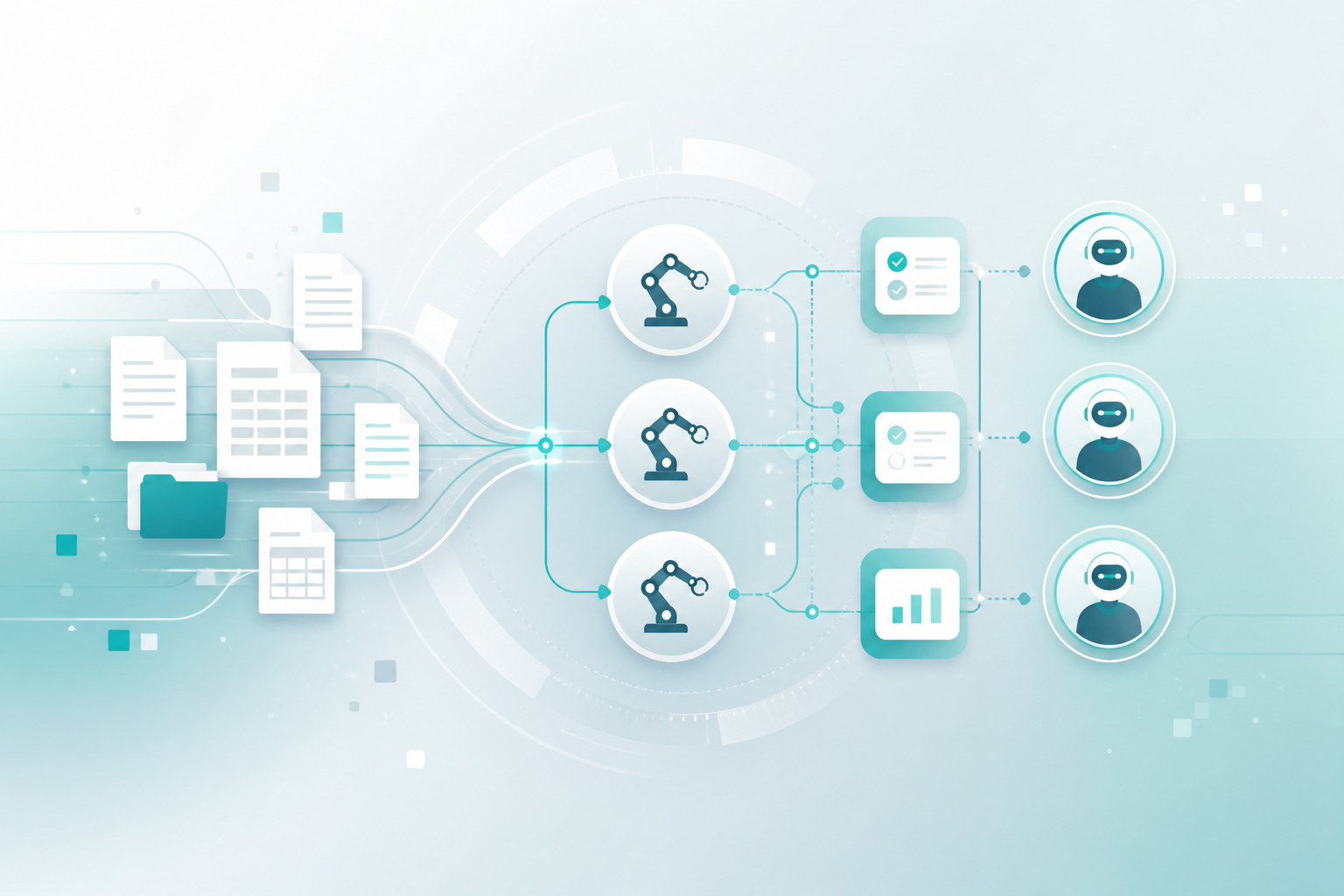
RPA vs agentic digital workers is not a replacement debate—it is a fit debate. Robotic process automation still wins on stable, rules-heavy, UI-driven tasks with clear exception paths. Agentic digital workers win when work needs judgment across systems, unstructured inputs, and adaptive sequencing. Enterprises that pick one hammer for every nail either overpay for brittle bots or over-govern experimental agents.
What each term actually means in delivery
RPA typically means attended or unattended bots that follow scripted steps across applications—often by driving the user interface when APIs are missing. Strengths include predictability, audit of step execution, and fast wins on high-volume, low-variance processes such as invoice status checks, form filling, and report downloads.
Agentic digital workers combine language models with tools, memory, and policies so software can plan steps, call systems, and adapt when inputs vary. They are closer to a junior operator with guardrails than to a macro. Strengths include handling documents, ambiguous requests, and multi-system orchestration where the path is not fully known in advance.
In APAC shared services, banking ops, healthcare admin, and manufacturing back offices, both patterns show up. The useful question is which pattern matches process stability, data shape, and risk tolerance—not which is more fashionable this quarter.
Where RPA still wins
Choose RPA when most of the following are true:
- The process is documented and rarely changes week to week.
- Inputs are structured or semi-structured with known fields.
- Systems lack usable APIs, so UI automation is the practical bridge.
- Exceptions are few and already routed to humans with clear SLAs.
- Compliance wants deterministic replay of the same steps every time.
Classic fits include reconciliations with fixed layouts, bulk status updates in legacy screens, scheduled extractions, and swivel-chair transfers between two systems that will not be replaced soon. RPA also pairs well with existing BPM and queue tools: the bot executes; the workflow engine decides who handles exceptions.
RPA loses value when screens change often, when every case is a snowflake, or when the process is really knowledge work dressed up as a procedure. In those cases, maintenance cost climbs and business owners lose trust.
Where agentic digital workers win
Choose agentic approaches when:
- Requests arrive as email, chat, PDFs, or free-text tickets.
- The correct path depends on context retrieved from multiple systems.
- Drafting, classification, and summarization are a large share of the effort.
- APIs or events exist (or can be built) so the agent does not rely only on fragile UI clicks.
- Humans remain in the loop for approval on consequential actions.
Examples include intake triage with messy attachments, policy-aware draft responses, vendor query handling with knowledge retrieval, and guided case assembly for analysts. Agents are especially useful when RPA would require dozens of brittle branches for language and document variation.
Agents lose value when you need bit-identical repetition, when tool access is poorly controlled, or when evaluation and logging are treated as optional. Without identity controls, action allowlists, and review queues, digital workers become opaque automations.
A side-by-side decision lens
Use this comparison in architecture reviews:
- Process volatility: Low favors RPA; high favors agents with retrieval and policies.
- Input structure: Forms and tables favor RPA; documents and conversation favor agents.
- Integration style: UI-only legacy screens often start with RPA; API-rich landscapes favor agents and services.
- Exception rate: Low, known exceptions fit RPA; high, interpretive exceptions fit agents plus humans.
- Audit expectation: Step replay favors RPA; decision rationale plus tool traces favors well-instrumented agents.
- Change ownership: Business rule changes in a CoE playbook fit RPA; knowledge and prompt/policy updates fit agent platforms with content ops.
Many enterprises will run both. The anti-pattern is forcing agents into stable batch jobs—or forcing RPA into open-ended service desks.
Hybrid patterns that work in production
High-performing automation estates often combine patterns:
- Agent for intake, RPA for commit. An agent classifies and extracts; an RPA bot or API job posts the final transaction after validation.
- RPA for collection, agent for judgment. Bots gather screens and files; an agent summarizes and proposes next actions for a human.
- Workflow engine as the spine. BPM or case management owns state; RPA and agents are workers called at specific steps.
This keeps deterministic financial postings away from open-ended model behavior while still reducing manual triage. It also clarifies ownership: platform teams run bots and agent runtimes; process owners own policies and exception queues.
Cost, maintenance, and second-year reality
First-year demos hide second-year costs. RPA estates grow expensive when UI selectors break after every vendor patch and when undocumented bots multiply. Agent estates grow expensive when prompts, tools, and model versions change without regression tests, and when every team invents its own connector story.
Budget for:
- Monitoring and alerting on failure rates, not only happy-path throughput.
- Regression packs for critical processes (screen flows for RPA; gold transcripts and tool mocks for agents).
- Access reviews for bot accounts and agent tool credentials.
- A retirement path for automations when APIs replace UI hacks.
In regional delivery models spanning the Philippines and Singapore hubs, clear runbooks and follow-the-sun support matter as much as the automation technology. Unowned bots fail quietly; unowned agents fail loudly.
Governance differences you should plan for
RPA governance usually centers on bot credentials, change control for scripts, and segregation of duties for privileged screens. Agent governance adds model risk, prompt injection awareness, retrieval permissioning, and allowlists for tools that can write data.
Minimum agent controls for enterprise use:
- Per-tool authentication and least privilege.
- Human approval for irreversible or high-value actions.
- Full traces of retrieved context and tool calls for incident review.
- Environment separation: sandbox tools cannot touch production systems.
If your risk team is not ready for those controls, keep agents in read-and-draft mode and let RPA or APIs perform commits under existing controls.
Practical checklist: RPA, agent, or hybrid?
- Write the process in 10 steps or fewer. If you cannot, clarify the process before automating.
- Measure structured vs. unstructured input share for a real sample week.
- List systems touched and whether each has a supported API or event feed.
- Estimate exception rate and who handles exceptions today.
- Classify actions as read, draft, or commit; decide which may be autonomous.
- Score volatility of UI and business rules over the last two release cycles.
- Pick RPA, agent, or hybrid based on the decision lens above—not vendor roadmaps alone.
- Define KPIs: cycle time, straight-through rate, rework rate, and incident count.
- Assign a product owner and a technical owner before build starts.
- Plan the second-year maintenance model (CoE hours, regression, access reviews).
FAQ: RPA vs agentic digital workers
Should we freeze RPA investment because agents are coming?
No. Freeze bad RPA—unowned, undocumented, UI-fragile bots. Keep investing in stable, high-volume processes where RPA remains the simplest reliable worker.
Can agents replace our entire bot farm?
Unlikely in one program. Replace or wrap specific brittle bots where documents and judgment dominate. Leave deterministic batch posting where it works.
Do we need new skills?
Yes. RPA CoEs need stronger API and data skills over time. Agent programs need evaluation, retrieval, and security engineering—not only prompt writing.
What about AI features inside RPA platforms?
Document understanding and classification inside RPA suites can be valuable. Still apply the same fit tests: stability, evaluation, and clear commit boundaries.
How WC1 helps teams choose without hype
WC1 Entreventures delivers intelligent automation alongside AI, integration, and managed scale for APAC enterprises. That mix matters because the right answer is often a hybrid: agents for messy intake, APIs for durable integration, and RPA where legacy UI is still the bridge.
If you are under pressure to go agentic while an RPA estate already runs critical ops, contact WC1 to pressure-test fit, governance, and a phased path that protects production.
Bottom line: treat RPA vs agentic digital workers as a portfolio decision. Put deterministic work on deterministic tools. Put interpretive work on governed agents. Connect both through workflows your operators already trust.