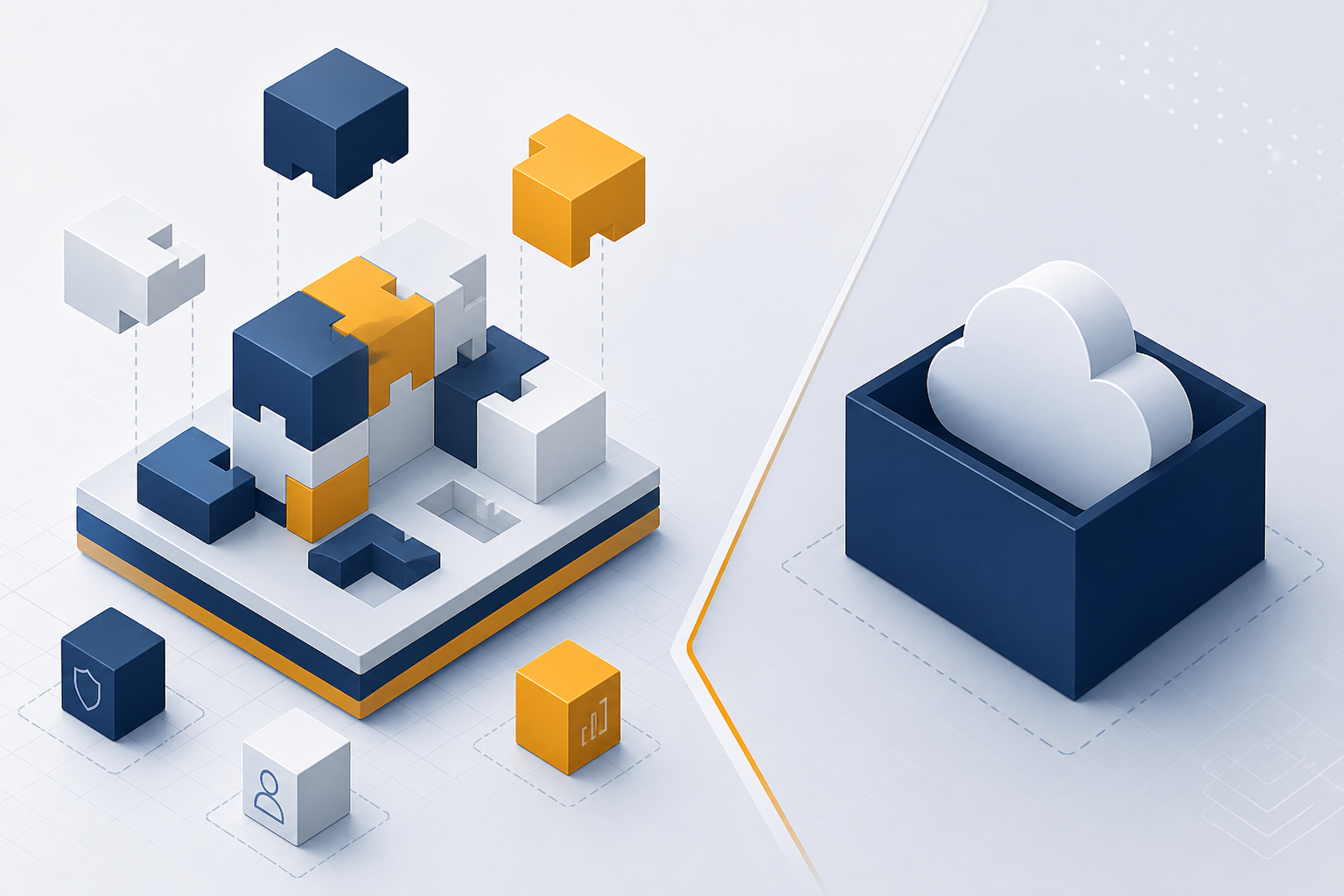
Custom software vs SaaS is not a brand preference—it is a control, cost-of-change, and data-residency decision. Growth teams win when they keep SaaS for commodity workflows and invest in custom software where differentiation, multi-country rollout rules, or Singapore PDPA / data residency constraints make off-the-shelf products brittle. This guide gives a practical decision frame you can use in one working session with product, finance, and security.
When custom software vs SaaS actually matters
Most mid-market teams in APAC already run a mix: CRM, HRIS, accounting, collaboration tools, and industry SaaS. That mix is healthy. Trouble starts when a growth initiative—new pricing, a partner portal, a regulated data path, or a multi-country operating model—gets forced into a SaaS configuration that was never designed for those edges.
Custom software beats SaaS when the workflow is the product (or a durable advantage), when change velocity in the vendor roadmap is too slow, or when compliance and residency requirements force architecture choices SaaS tenants cannot offer. SaaS wins when the process is standard, the vendor ecosystem is mature, and your differentiation lives elsewhere.
The goal is not purity. The goal is a deliberate split: buy what is commodity, build what must fit your operating model across markets. Teams that treat every request as a build create unmaintainable estates; teams that treat every request as a buy create spreadsheet workarounds and shadow IT. The discipline is knowing which bucket a capability belongs in before procurement or engineering starts spending.
In practice, the loudest stakeholder request is a poor proxy for the right build decision. Finance may want a custom dashboard because a SaaS report is ugly; that is rarely a reason to build. Revenue operations may need a partner commission engine that no CRM marketplace app can express without fragile automation; that is often a reason to compose or build.
A decision frame growth teams can score in one session
Score each candidate capability from 1 (favor SaaS) to 5 (favor custom) on six dimensions. Prefer custom when the average is 4+ and at least two of differentiation, residency, or integration criticality score a 5. Keep a written non-goal list so the workshop does not expand into a platform fantasy.
1. Differentiation and change velocity
If competitors can buy the same SaaS module tomorrow, you are not building moat—you are renting parity. Custom software earns its keep when the workflow encodes pricing logic, partner economics, underwriting rules, clinical pathways, or fulfillment steps that change often and must stay owned by your team.
Ask a blunt question: if the vendor shipped your exact feature next quarter, would you still care who owns the code? If the answer is no, buy. If the answer is yes because the logic is strategic or highly specific, build or compose. Also track how often the rules change. High-change strategic logic favors ownership; low-change commodity logic favors SaaS.
2. Multi-country rollout complexity
APAC multi-country rollout rarely means “flip a language pack.” Tax treatment, invoice formats, identity providers, local payment rails, and support hours differ by market. SaaS multi-tenant features help when the vendor already supports your country set. Custom (or heavily composed platforms) helps when you need country packs, feature flags per market, and controlled rollout without waiting on a global vendor queue.
Design for Singapore as a first-class market with clear data boundaries, then extend to the Philippines and other countries with explicit country packs—not one mega-tenant configuration that breaks when a second market goes live. Country packs should include localization, compliance hooks, and integration endpoints, not only translated strings.
3. Singapore PDPA and data residency as design constraints
Treat Singapore PDPA obligations and data residency expectations as architecture inputs, not contract footnotes. Map which personal data classes are collected, where they are stored and processed, who can access them, and how retention and deletion work. If a SaaS region or subprocessors cannot meet your residency posture—or if you cannot evidence access controls for audits—custom or private deployment patterns may be safer than stretching a public SaaS tenant.
Do not invent compliance theater. Document lawful bases, retention, and cross-border transfers with legal counsel. Use PDPA language to drive concrete choices: encryption, access logging, data localization options, and vendor due diligence. Where MAS TRM expectations influence technology risk discussions in financial services contexts, align early with risk—without claiming certifications you do not hold.
4. Integration criticality
If the capability must sit in the middle of ERP, CRM, HIS, banking rails, or warehouse systems, evaluate API quality, eventing, and idempotency—not just UI demos. SaaS with strong APIs can still win. Custom wins when you need an API facade, orchestration layer, or domain service that vendors will not expose cleanly. For related patterns, see WC1’s note on API-first integration patterns.
5. Total cost of change, not year-one license
Compare three-year cost of change: configuration debt, seats that grow with headcount, professional services for every edge case, and opportunity cost when the roadmap says no. Custom has build and run cost; SaaS has subscription and adaptation cost. Growth teams often undercount the second and overcount the romance of owning code.
Include the cost of people: administrators, integration engineers, vendor managers, and on-call. A cheap subscription with expensive human glue is not cheap. A custom service with clear ownership and automated tests can be cheaper to evolve than a maze of SaaS automations nobody wants to touch.
6. Operating ownership
Who will own releases, incidents, and product backlog after launch? If you lack product and engineering ownership, SaaS (or a managed build with clear handover) is safer. Custom without an owner becomes shadow IT with a nicer logo. Write the RACI before you write the statement of work.
Patterns that work: compose, don’t rewrite everything
A practical APAC pattern is hub-and-spoke: SaaS systems of record at the edges, a thin custom domain layer for rules and workflows that must be owned, and an integration plane that keeps cores running while you evolve. Avoid big-bang rewrites. Prefer strangler-style replacement where legacy constraints appear.
- Use SaaS for CRM, email, collaboration, and standard finance modules when markets are supported.
- Build custom for partner portals, pricing engines, regulated workflows, and country-specific orchestration.
- Keep identity, audit logs, and data classification consistent across both.
- Feature-flag country packs so Singapore, Philippines, and later markets do not share one brittle config.
- Prefer API facades over point-to-point scripts so vendors can be swapped without rewriting the business.
Composition also means knowing when a low-code layer is enough. Some workflows belong in a governed automation platform rather than a greenfield app. The decision frame still applies: if the platform cannot express your rules without brittle hacks, you have learned something important before you sunk a year into configuration.
Worked scenarios (illustrative, not case studies)
Partner portal with country-specific commercials. If partner tiers, rebates, and document packs differ by market and change quarterly, a custom portal on top of SaaS CRM often beats forcing everything into CRM automation.
Internal workflow that is mostly standard. Expense, PTO, and basic ticketing usually belong in SaaS. Custom only if you have unusual approval graphs tied to regulated data paths.
Customer-facing scheduling that encodes your service model. When the booking rules are your product, custom or platform-compose beats a generic scheduler that fights your rules.
Analytics that must join sensitive operational data. Prefer a governed warehouse and semantic layer over exporting personal data into unmanaged SaaS BI tools. Architecture here is a PDPA decision as much as a tooling decision.
Checklist: custom software vs SaaS workshop
Run this in 90 minutes with product, finance, security, and an integration lead.
- Name the workflow and the user jobs in one paragraph.
- List data classes and whether Singapore PDPA / residency rules apply.
- Score differentiation, multi-country complexity, residency, integration, cost of change, and ownership (1–5).
- Identify which SaaS vendors already cover your country set and API needs.
- Decide buy / build / compose; write non-goals explicitly.
- Estimate three-year cost of change for each option—not only year-one fees.
- Assign a product owner and a security reviewer before any build starts.
- Define a 90-day MVP boundary if custom is chosen.
- Agree how success will be measured: cycle time, error rate, audit readiness, or revenue enablement—not “we shipped an app.”
Anti-patterns to avoid
Building a clone of SaaS. If you are recreating a commodity CRM, stop. Buy it.
Ignoring residency until procurement. Residency and PDPA affect architecture early.
Custom without product ownership. Software without a backlog owner decays.
SaaS sprawl with no integration plan. Five best-of-breed tools without an API strategy create manual work and reconciliation risk.
One global config for every country. Multi-country without country packs produces brittle exceptions.
How WC1 helps growth teams decide
WC1 Entreventures (AI Solutions Corporation) works with APAC mid-market and enterprise teams on custom software, integration, cloud, and automation—so buy-vs-build choices land in systems operators will run. We help you score workflows, map PDPA and residency constraints, and design composed architectures rather than all-or-nothing rewrites.
If you are weighing custom software vs SaaS for a multi-country rollout, contact WC1 to pressure-test the decision frame against your systems and governance model.
FAQ: custom software vs SaaS for growth teams
Is custom always more expensive?
Not over a multi-year horizon when SaaS requires heavy services, seat growth, and workarounds. It can be more expensive if the problem is commodity. Score cost of change honestly.
Can we start SaaS and migrate later?
Yes, if you keep data exportable, avoid hardcoding business rules only in vendor automation, and design integration contracts you own. Migration cost is lower when you planned for it.
Does PDPA mean we must build custom?
No. Many SaaS vendors can support PDPA-aligned processing with the right region, DPAs, and controls. Custom becomes relevant when residency, access evidence, or workflow constraints exceed what the tenant model allows.
What should we never customize first?
Payroll tax engines, commodity email, and heavily regulated finance ledgers are usually poor first custom bets unless you are in that product business. Prefer vendors with proven country coverage.
Choose deliberately: SaaS for parity, custom for advantage and constrained multi-country reality. That is how custom software vs SaaS stops being a slogan and becomes an operating decision growth teams can defend.