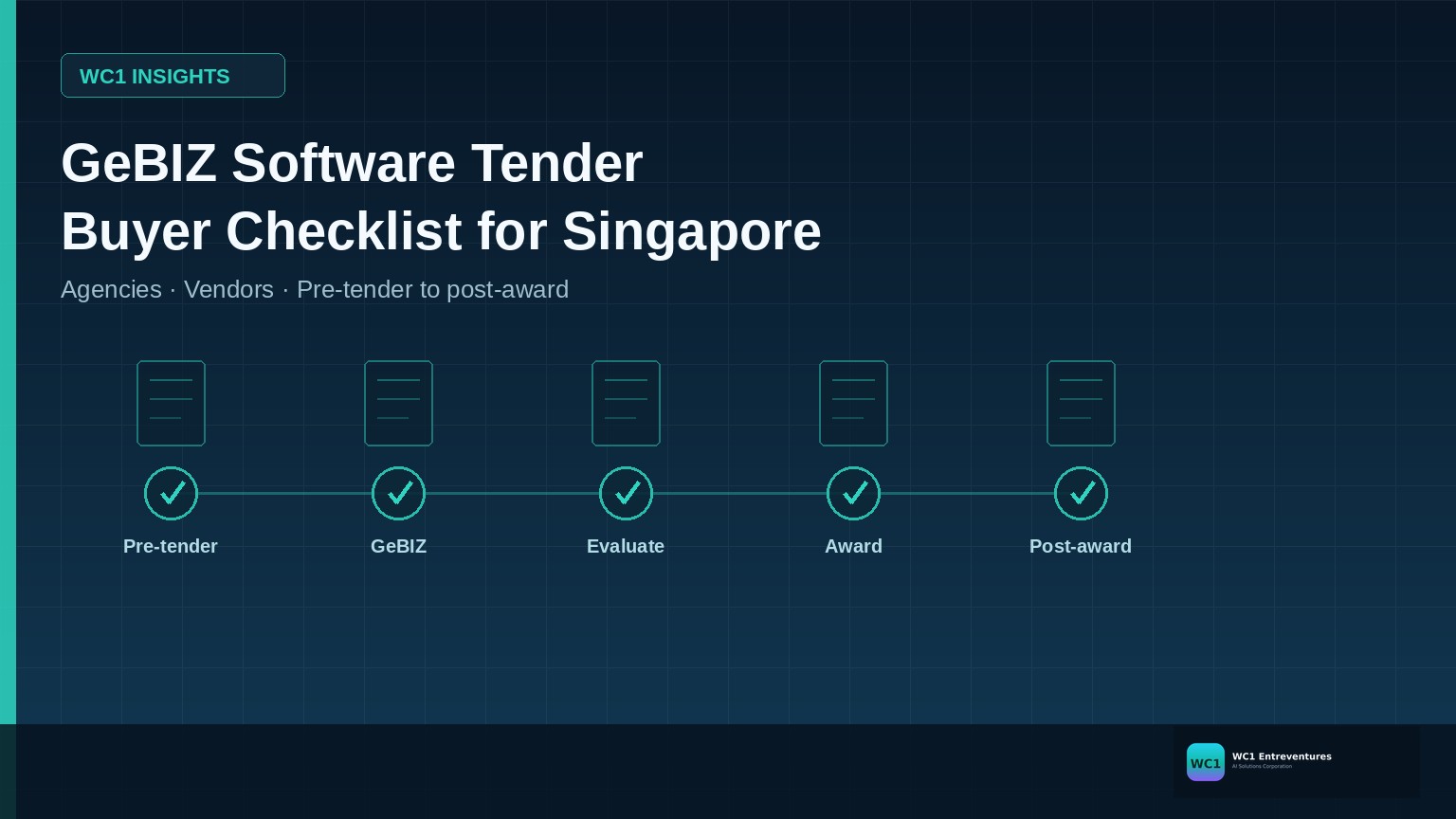
A GeBIZ software tender is won or lost long before the portal submission clock hits zero. Singapore agencies and vendors who treat GeBIZ as a last-minute upload window miss the real work: clarifying procedure (quotation vs tender vs Tender Lite), locking Corppass and Trading Partner access, writing testable requirements, and assembling evaluation evidence that survives scrutiny. This checklist walks Pre-tender → During GeBIZ → Evaluation → Award/contract → Post-award for custom and ICT software buys. Educational only—not legal or procurement advice. Confirm live rules on GeBIZ and the Singapore Government procurement guide.
Who this is for — and who should skip
For: Singapore public-sector buyers and project owners scoping ICT or custom software through GeBIZ; vendor bid managers preparing responses as GeBIZ Trading Partners; procurement and compliance partners who need a stage checklist in SGD with PDPA and acceptance hygiene in view. Pairs with our Singapore RFP scoring matrix and SOW red-flags guide.
Skip if: you only need a Corppass how-to (use official Corppass help); you want invented award odds or fee-arbitrage tips; you are bidding private-sector RFPs with no GeBIZ step; or you already signed a statement of work and are hunting a portal after the fact—GeBIZ does not fix a broken brief.
Direct answer: match the procedure, then run the stage checklist
Per Singapore’s published procurement regime on GeBIZ, estimated value (excluding prevailing GST) drives the method:
- Small Value Purchase — up to S$6,000; may be bought directly from known sources.
- Quotations (often Invitation to Quote / ITQ) — estimated value up to S$90,000.
- Tenders (Invitation to Tender / ITT and related forms) — estimated value above S$90,000, via Open, Selective, or Limited procedures.
- Tender Lite — a tender sub-category with estimated value not exceeding S$1 million and fewer/simpler contract conditions; goods and services from end April 2024, construction from May 2025, and Infocomm Technology (ICT) from end April 2026 (per GeBIZ FAQ / MOF announcements).
Agencies publish notices on GeBIZ; suppliers register as GeBIZ Trading Partners (companies with a UEN typically via Corppass) before downloading full documents and submitting electronic responses. Awards are not “lowest bid only”—GeBIZ’s own FAQ states evaluation covers compliance, quality, timelines, reliability, and after-sale service. Your GeBIZ software tender checklist should therefore protect specification quality and evidence packs, not just price cells.
Original element: GeBIZ software tender buyer checklist (stage matrix)
Print this matrix. Mark Owner, Done, and Evidence for each row before you open the opportunity or press Submit. Vendors can mirror the same stages as a bid readiness board.
| Stage | Buyer must lock | Vendor must lock | Evidence / artefact | Common trap |
|---|---|---|---|---|
| 1. Pre-tender | Need vs catalogue; estimated value band; Open / Selective / Limited intent; PDPA / data-map sketch; outcome metrics | UEN / ACRA status; Corppass e-service for GeBIZ; Trading Partner AR ready; capability vs GSR/supply-head if stated | Business case; rough SGD range; data inventory; draft acceptance criteria | Writing ITT language for a quotation-sized buy—or the reverse |
| 2. During GeBIZ | Clear ITT/ITQ pack; clarifications logged; Closing date visible; evaluation weights published; login-gated docs complete | Watchlist + download; response before close; acknowledgement after submit; no shared Singpass/Corppass | Published notice; Q&A log; submitted response ID / acknowledgement | Treating header browse as full docs; last-hour upload without acknowledgement check |
| 3. Evaluation | Separate commercial vs technical where two-envelope; score to published criteria; compliance gate before price romance | Map every mandatory clause; evidence pack (cases, CVs, AMS, PDPA DPA draft); no silent non-compliance | Scoring sheet; compliance matrix; clarification replies | Re-weighting criteria after prices open; vendors bidding hope instead of stated requirements |
| 4. Award / contract | Award notice hygiene; Conditions of Contract (incl. Tender Lite sections if used); IP, AMS, exit, change control | Confirm award in GeBIZ; read COC sections; price vs scope fidelity; subcontract disclosure if required | Award record; signed / accepted COC; SOW annex; DPA | Assuming “award = start coding” without acceptance and AMS schedules |
| 5. Post-award | Kick-off acceptance plan; Vendors@Gov / e-invoice path for ministries & statutory boards; variation control | Banking / Vendors@Gov setup; milestone evidence; invoice only against accepted deliverables | UAT evidence; invoice trail; variation log | Scope creep without GeBIZ/contract variation discipline; invoice before acceptance |
Stage 1 — Pre-tender: decide the buy before you write the notice
Buyers: separate problem from preferred product. If the need is a bounded productivity package, check whether a non-tender path or a narrower specification is honest. If the need is differentiating workflows, integrations, or control depth, write outcomes and acceptance tests—not a vendor brochure. Use the Singapore custom software cost guide (SGD) for driver discipline. If grant versus self-funding affects the buy, note that grants are separate from GeBIZ procedures. Enterprise Singapore’s grant support is public context only: its EDGE Grant replaced PSG and EDG for new applications from 30 September 2026, after the older schemes closed on 29 September. Enterprise Singapore decides eligibility, so check the current terms on its site.
Value band matters. MOF’s published guide routes Small Value Purchases (up to S$6,000), Quotations (up to S$90,000), and Tenders (above S$90,000). Mis-banding creates either under-governed awards or over-heavy process. For ICT in the Tender Lite window (end April 2026 onward per GeBIZ FAQ), expect fewer/simpler conditions arranged in standard, sector, and tender-specific sections—still a tender, not a casual quote.
Vendors: pre-tender work is access and fit. Local entities with a UEN need Corppass access to GeBIZ e-services, then GeBIZ Trading Partner registration (GeBIZ FAQ: local GTP applications approve on successful submission; first Authorised Representative account is free; additional AR accounts carry a published annual fee). If a notice requires Government Supplier Registration for a GRA supply head, that is separate from GTP registration—apply early via GeBIZ when your capability path needs it. Scan the indicative procurement opportunities listing (public guidance: opportunities exceeding S$200,000 are listed as a guide) so you are not discovering ITT packs the week of close.
Stage 2 — During GeBIZ: documents, clarifications, acknowledgement
Notices appear on GeBIZ; full quotation/tender attachments are typically available after login to Trading Partners. Header browse is not enough for a software response. Buyers should publish evaluation criteria and weights up front, keep a clarification channel, and avoid silent scope changes after close. Vendors should add the opportunity to a watchlist, download the pack, ask clarifying questions early, and submit with time to see the on-screen acknowledgement—GeBIZ FAQ directs suppliers to the Responses link to confirm what was submitted. Edits remain possible only before the closing date.
Security hygiene is non-negotiable: Corppass and Singpass are individual credentials (GeBIZ FAQ: do not share). Concurrent login from the same user across windows is unsupported. Treat the response as a binding offer under GeBIZ Trading Partner terms for both quotations and tenders submitted through the portal.
Stage 3 — Evaluation: compliance first, then value
Singapore’s published procurement principles emphasise fairness, openness, competitiveness, and best value for money—not lowest price alone. For software, that means a compliance gate (mandatory clauses, licences, data residency if stated, PDPA processor readiness) before aesthetic demos. Two-envelope tenders separate technical and price proposals; do not open price romance until technical compliance is scored against published criteria.
Buyers: reuse a transparent scorecard—our RFP scoring matrix and vendor scorecard are built for custom software evaluation discipline. Vendors: map every mandatory requirement to an evidence cell (prior case, architecture note, AMS plan, draft DPA). Silent non-compliance is a self-disqualification dressed as optimism.
Stage 4 — Award and contract: COC, IP, AMS, exit
Check award status in GeBIZ after evaluation. Read the Conditions of Contract carefully—especially if Tender Lite applies, where MOF publishes streamlined COCs with standard, sector, and tender-specific sections. Software contracts still need clear IP ownership or licence scope, acceptance tests, application management services (AMS), change control, and exit assistance. Pair the GeBIZ award with a SOW that survives the red flags in our procurement SOW guide.
Where personal data is processed, align with the PDPA: roles (controller/processor), overseas transfer, breach notification expectations, and subprocessors. Agency-specific ICT policies (for example IM8-aligned controls where they apply to your organisation) belong to your compliance owner—do not invent control lists in the tender pack.
Stage 5 — Post-award: acceptance, invoicing, variations
Kick off with a written acceptance plan and milestone evidence rules. For ministries and statutory boards, GeBIZ FAQ notes that Trading Partners submit invoices online via Vendors@Gov. Do not invoice against unaccepted code. Variations belong in the contract change process—not chat threads. Debarment is a separate risk: debarred suppliers may fulfil existing obligations but generally cannot be awarded new public-sector contracts during the debarment period (see GeBIZ procurement regime / FAQ).
Worked example (illustrative — not an award prediction)
A Singapore statutory board needs a case-management portal integrated to an existing CRM, with audit trails and a vendor AMS year. Estimated value sits clearly above S$90,000, so the team plans an Open Tender (and checks whether Tender Lite ICT timing and scope fit when that path is live). Pre-tender: they write outcome metrics (cycle time, audit completeness), a PDPA data map, and UAT evidence rules. During GeBIZ: the ITT publishes weights (e.g. technical / AMS / price), clarifications close a week before the deadline, and three Trading Partners submit with acknowledgements. Evaluation: compliance gate removes one non-responsive bid; remaining scores follow the published matrix—no re-weighting after prices open. Award: COC + SOW annex + DPA signed; AMS hours and exit assistance are scheduled. Post-award: Vendors@Gov invoicing only after UAT sign-off. No fake “win probability” appears in the board pack—only procedure fit and evidence quality.
Mistakes and traps
- Wrong procedure for the value band — treating a tender-sized software buy like a casual quote, or over-engineering a small purchase.
- Access theatre — discovering Corppass / GTP / GSR gaps days before close.
- Specification tourism — copying a vendor brochure into the ITT so only one response can “fit.”
- Evaluation drift — changing weights after seeing prices; ignoring mandatory non-compliance.
- Contract amnesia — award celebration without IP, AMS, acceptance, or PDPA schedules.
- Invoice-before-acceptance — cashflow pressure that creates disputes and debarment risk downstream.
Decision framework: five yes/no gates
- Is the estimated value band (excl. GST) honest? If no, stop and re-cost before choosing Small Value / Quotation / Tender / Tender Lite.
- Are Corppass + GeBIZ Trading Partner (and GSR if required) ready? If no, fix access before writing the narrative.
- Are requirements testable and evaluation weights published? If no, you are inviting disputes, not competition.
- Does every mandatory clause have an evidence cell? If no, the bid or the evaluation pack is incomplete.
- Do award documents cover acceptance, AMS, IP/exit, and PDPA? If no, do not treat portal award as delivery start.
If any gate fails, delay the notice or the submit button. Speed without gates is how software tenders become remediation projects.
FAQs
Do I need to be a GeBIZ Trading Partner to respond?
Yes for electronic tenders, quotations, and qualifications—GeBIZ FAQ states suppliers must register as Trading Partners before they can log in to respond.
Is award always to the lowest price?
No. GeBIZ FAQ and the procurement guide emphasise value for money: compliance, quality, timelines, reliability, and after-sale service matter alongside price.
What is Tender Lite for ICT?
Per GeBIZ FAQ, Tender Lite is a tender sub-category not exceeding S$1 million with fewer/simpler conditions; ICT coverage is stated to implement from end April 2026. Confirm the live notice and COC for your opportunity.
How do ministries and statutory boards get invoiced?
GeBIZ FAQ points Trading Partners to online invoicing via Vendors@Gov after delivery per contract terms.
Is this legal advice?
No. Educational checklist only. Confirm documents, thresholds, and obligations on official GeBIZ / MOF pages and with your advisors.
What to do next
Copy the stage matrix into your bid or procurement pack, mark owners, and close the five gates before you publish or submit. For delivery scoping after a clean award path, see WC1’s custom software Singapore and software development company Singapore pages—or contact WC1 with your GeBIZ notice reference and value band (no invented win odds).
Educational content only. Not legal, procurement, or financial advice. Singapore Government procurement rules, GeBIZ fees, and Tender Lite coverage change—verify on gebiz.gov.sg and related official portals before decisions.