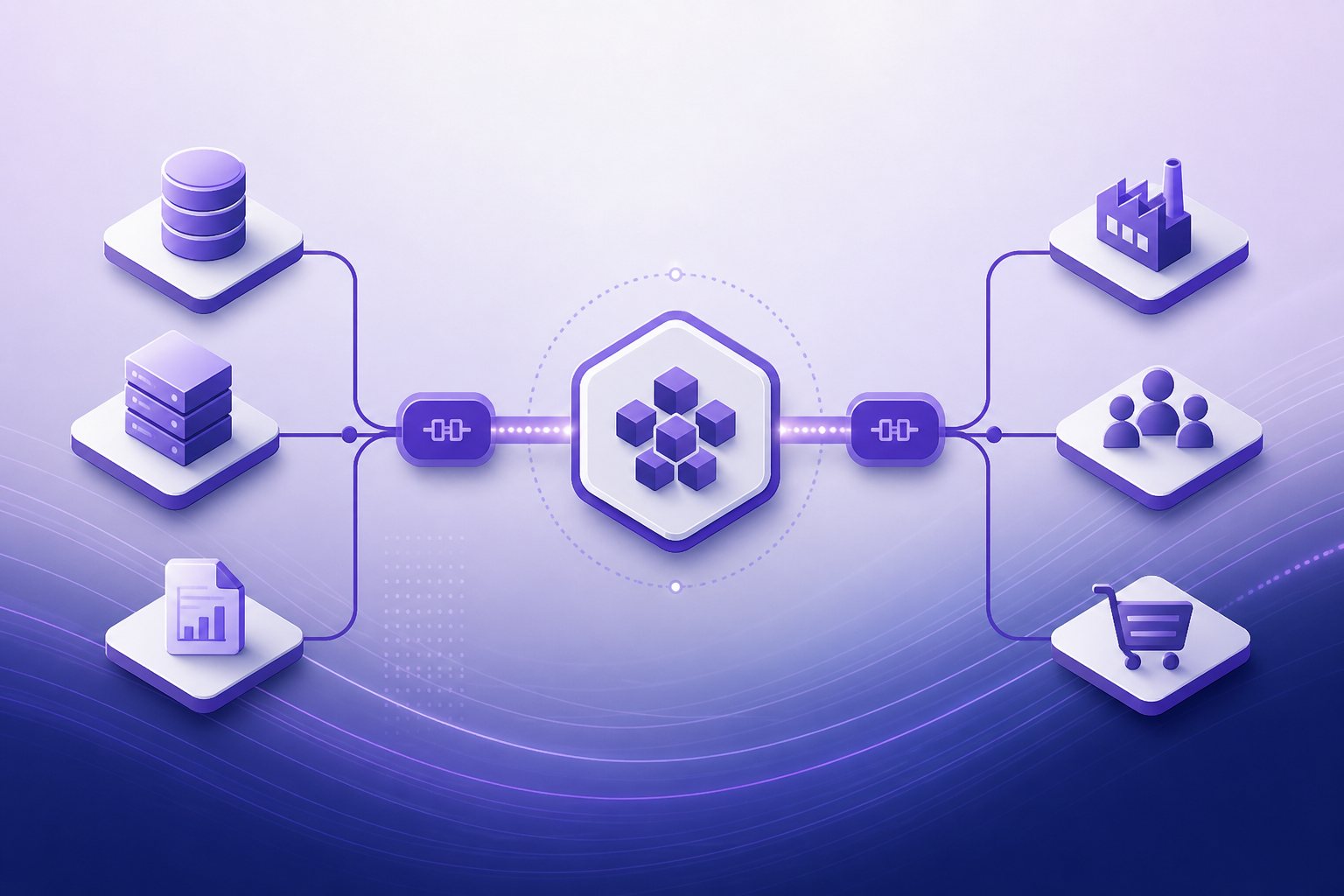
API-first integration ERP CRM landscapes stay maintainable when systems of record expose stable contracts and when glue code is treated as a product—not a ticket pile. Hospitals, banks, and multi-country operators across APAC still run ERP, CRM, and HIS (hospital information systems) as authoritative cores. Point-to-point scripts work until the next upgrade. An API-first pattern works through upgrades.
What “API-first” means when legacy is still king
API-first does not mean rewriting every monolith. It means new integrations prefer versioned interfaces—REST, events, or well-defined file contracts with schemas—over silent database reads and UI scrapes. When a native API is missing, you still isolate adapters behind your own anti-corruption layer so consumers do not couple to vendor tables.
For ERP, CRM, and HIS estates, the practical goal is clear ownership of:
- Which system is source of truth for each domain object (patient, item, invoice, account, encounter).
- Which channels may write versus read.
- How breaking changes are versioned and communicated.
- How failures, retries, and idempotency are handled.
Core patterns that survive upgrades
1. System-of-record APIs with explicit write paths
Publish read models widely; restrict writes to controlled services. ERP financial postings, CRM opportunity updates, and HIS clinical orders should not be writable from every departmental script. Gate writes through services that enforce validation and audit.
2. Event-driven propagation for cross-domain sync
When a customer is created in CRM or an encounter closes in HIS, downstream systems often need near-real-time awareness. Domain events—or change data capture feeding a controlled event bus—beat nightly full extracts for many operational use cases. Keep payloads business-meaningful and include correlation IDs.
3. Anti-corruption adapters
Vendor APIs change. Your internal canonical model should not. Adapters translate between SAP/Oracle/Dynamics/Salesforce/HIS vendor shapes and your stable internal contracts. This is where most of the durable engineering investment belongs.
4. Orchestration versus choreography—choose deliberately
Long-running processes (onboarding, claims, procure-to-pay) often need orchestration with visible state. Simple fan-out notifications may use choreography. Mixing both without documentation creates undebuggable flows. Prefer a workflow engine for multi-step business processes that need compensation and human tasks.
5. Contract testing and consumer-driven expectations
Integration breaks in production when producers change fields silently. Add contract tests between critical consumers and providers. Treat API specs as release artifacts.
ERP, CRM, and HIS: different pressures, same discipline
ERP integrations often involve financial controls, batch windows, and strict idempotency. Prefer official APIs or approved middleware; avoid reading posting tables directly. Design for replay-safe messages.
CRM integrations are usually more interactive and identity-sensitive. Align customer keys early. Prevent duplicate person/account records with clear master data rules before you sync at scale.
HIS landscapes add clinical safety, privacy, and sometimes HL7/FHIR realities alongside older proprietary interfaces. Never treat clinical write paths casually. Prefer standards-based interfaces where available, and keep human workflows in the loop for high-impact actions.
Across all three, master data management is not optional decoration. If customer, item, and site codes disagree, every API you build will amplify the mess.
Security and operational baselines
Enterprise API-first programs need shared baselines:
- OAuth2/OIDC or mutual TLS for service identity—no shared passwords in config files.
- Least-privilege scopes per consumer.
- Rate limits and back-pressure so a chatty digital channel cannot starve finance closes.
- Centralized observability: latency, error rates, poison messages, and replay tools.
- Data classification on payloads; mask or tokenize sensitive fields in lower environments.
For APAC deployments, also document residency constraints: which payloads may cross borders, and which must stay in-country or in private networks.
When files and RPA still appear—and how to contain them
Some vendor modules still only speak flat files or screens. Contain them:
- Wrap file drops behind a validated ingestion service with schema checks.
- Use RPA only as a temporary adapter behind the same internal API your other consumers call.
- Track these adapters as technical debt with retirement criteria when vendor APIs become available.
The mistake is letting every department invent its own file format and SFTP folder. That is how upgrades become forensic archaeology.
Ownership model that keeps glue from rotting
Assign product owners for integration domains (customer sync, inventory availability, billing events). Platform teams provide the API gateway, event bus, and CI templates. Business systems teams own vendor-side configuration. Without named owners, “integration” becomes everyone’s side job and nobody’s priority during upgrade season.
Practical checklist: API-first for ERP, CRM, and HIS
- Inventory interfaces: API, event, file, DB read, UI automation—and mark each as approved or debt.
- Publish a source-of-truth matrix for critical entities.
- Define canonical IDs and mapping rules before building new syncs.
- Require versioned contracts and changelog discipline for producer teams.
- Add idempotency keys on all write APIs that can be retried.
- Stand up contract tests for the top consumer-provider pairs.
- Centralize auth, logging, and alerting for integration traffic.
- Document residency and retention for cross-border flows.
- Time-box RPA/file adapters with exit criteria.
- Run an upgrade dry-run that includes integration consumers, not only the core system.
Versioning, deprecation, and upgrade seasons
ERP and HIS upgrades are where brittle integrations fail publicly. Treat versioning as an operational practice:
- Prefer additive changes; avoid renaming fields in place.
- Run dual versions only with a clear sunset date and consumer migration tracking.
- Include integration consumers in upgrade war rooms with named contacts.
- Keep golden transaction samples for regression (create order, update patient demographics, post invoice) that can be replayed in lower environments.
Deprecation communications should reach application owners, not only middleware specialists. Many breakages happen because a departmental app was never on the distribution list.
Observability that makes failures diagnosable
When a CRM update never reaches billing, teams need more than “the API returned 500.” Instrument correlation IDs end to end, capture business keys (order ID, patient ID) in structured logs with privacy controls, and provide replay tooling for idempotent consumers. Dead-letter queues without playbooks simply become expensive archives.
Define severity based on business impact: a delayed analytics sync is not the same as a blocked medication order interface. On-call rotations should know which flows are clinical or financial critical versus best-effort.
Building the integration backlog like a product
Rank integration work by risk reduction and enablement—not by whoever shouted last. A healthy backlog mixes:
- Debt retirement (replace DB reads with APIs).
- Reliability improvements (timeouts, retries, circuit breakers).
- New capabilities that unblock digital channels.
- Documentation and contract test coverage for fragile pairs.
Review that backlog with ERP, CRM, and HIS owners monthly. Integration without product discipline drifts back into ticket-driven glue.
For Singapore-specific examples of these patterns, see healthcare software in Singapore under the PDPA and InvoiceNow-ready ERP integrations.
FAQ: API-first integration ERP CRM (and HIS)
Is an ESB mandatory?
No. Some estates use an integration platform or iPaaS; others use lighter API gateways plus events. What is mandatory is clear contracts, ownership, and operational visibility—not a specific product logo.
Should we sync everything in real time?
No. Match freshness to business need. Financial close may tolerate batches; bedside or customer-facing availability may not. Over-syncing creates load and conflict.
How do we handle vendor lock-in?
You cannot eliminate vendor platforms, but you can isolate them behind adapters and keep canonical models under your control. That is the practical anti-lock-in strategy.
Where do AI and automation fit?
They should consume the same governed APIs and events—not bypass them with privileged database access. That keeps AI features from becoming another unmanaged integration path.
How WC1 delivers integration that lasts
WC1 Entreventures builds API-first integration alongside custom software, cloud, automation, and AI delivery for APAC enterprises. The point is durability: integrations that survive ERP upgrades, CRM expansions, and HIS module changes because contracts and ownership were designed up front.
If your landscape is held together by scripts and tribal knowledge, contact WC1 to map patterns, debt, and a sequenced path toward API-first operations.
API-first integration ERP CRM programs succeed when truth is explicit, writes are controlled, adapters absorb vendor change, and someone owns the glue. That discipline is what keeps HIS, finance, and customer platforms from becoming a permanent emergency.